Open mysteries at the core
The last article covered what's measured about Sagittarius A*. This one is about where the measurements stop.
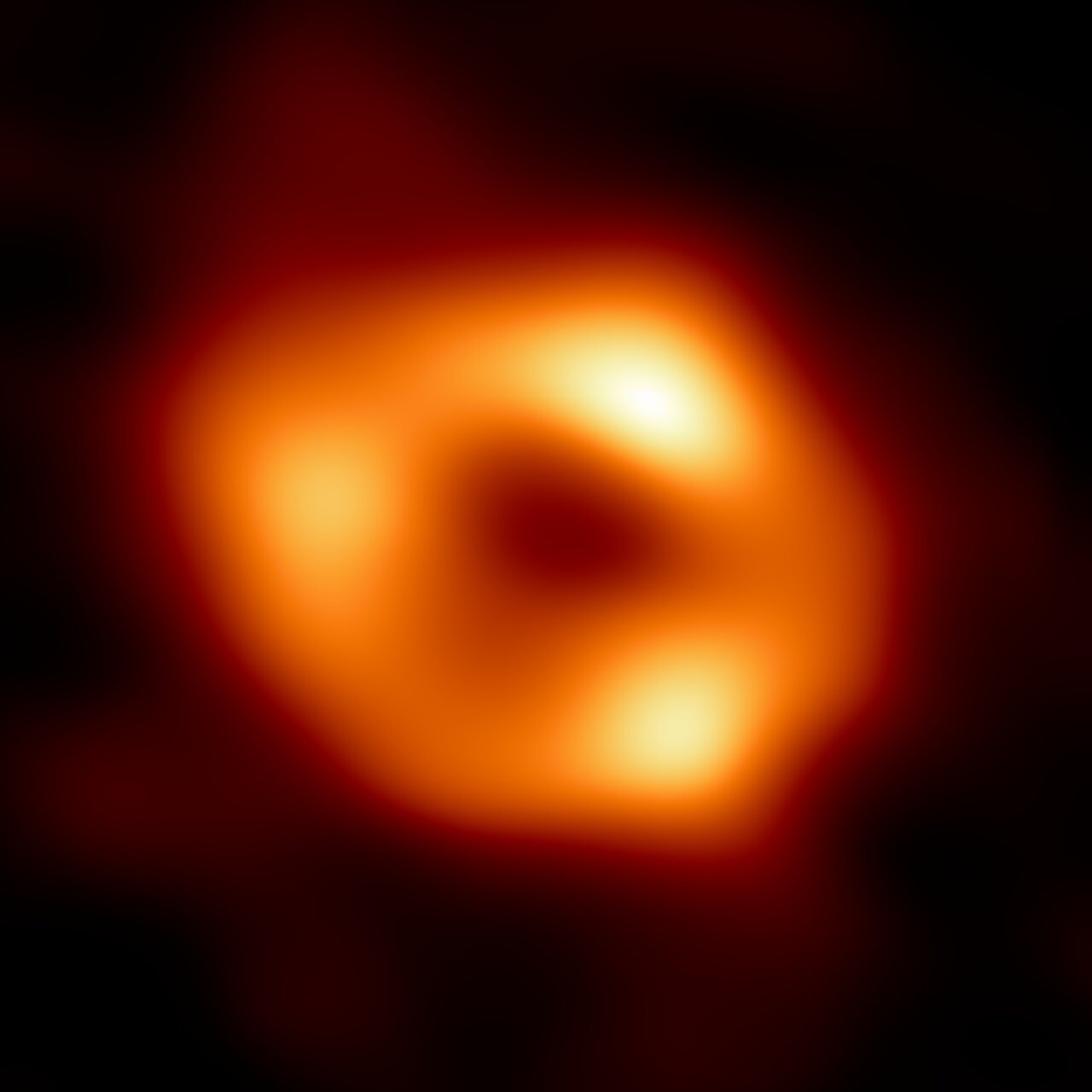
Our galaxy's center still holds puzzles nobody has solved. Each gets the same treatment below: what's established, and what's unresolved.
None is a crisis for physics. Every test of gravity near Sgr A* so far has been consistent with general relativity. These are questions about what is there and how it got there.
First, a note on the flicker
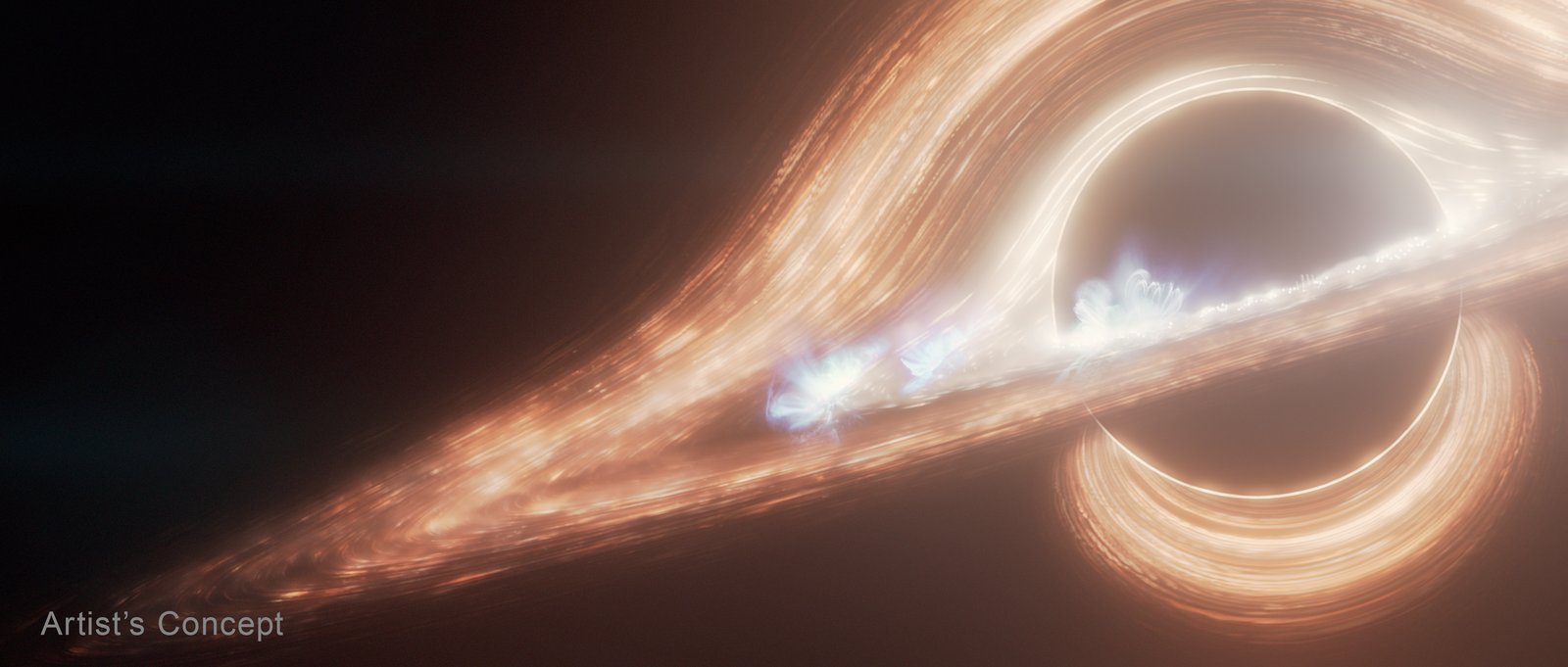
Sgr A* is never quiet. According to NASA, JWST found that the disk around the black hole produced five to six big flares per day, with smaller bursts in between. NASA describes it as "a constant stream of flares with no periods of rest."
The flares change on timescales of seconds, and the authors infer magnetic fields of about 40–90 gauss (Yusef-Zadeh et al. 2025). GRAVITY tracked some flares as a hot spot looping close to the innermost stable orbit.
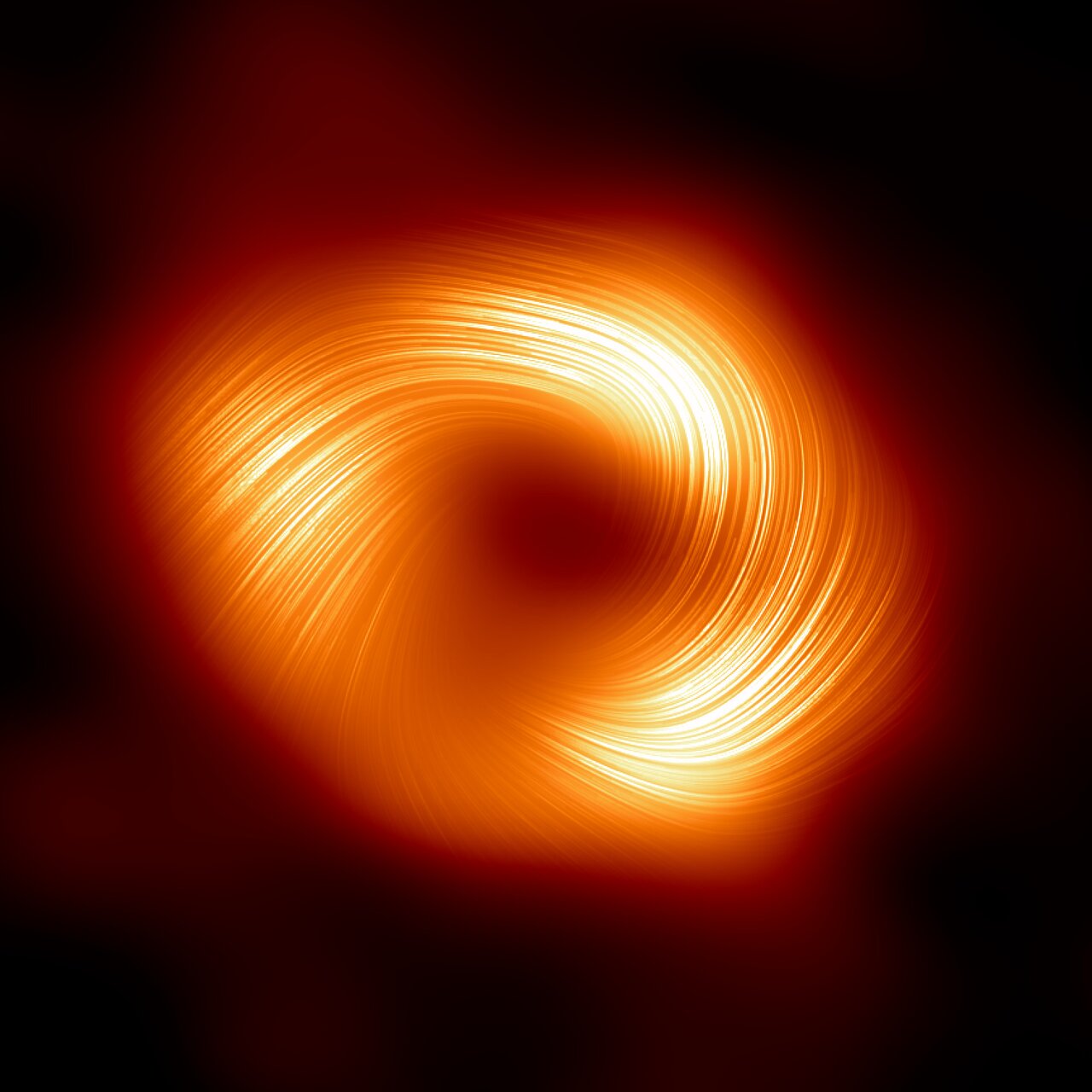
Unresolved: exactly what physical process drives these flares is still being modeled.
These flares pose no hazard to Earth. They come from hot gas around a black hole about 27,000 light-years away, and even the brightest are so faint here that only the most sensitive telescopes can detect them.
1. The paradox of youth
Established. The stars closest to Sgr A* include young, massive ones. Spectra suggest S2, the best-tracked of them, is a hot, massive star of roughly 15 solar masses, younger than about 10 million years (Ghez et al. 2003, ApJ; arXiv). At closest approach it swings within about 120 AU of Sgr A* (GRAVITY 2018).
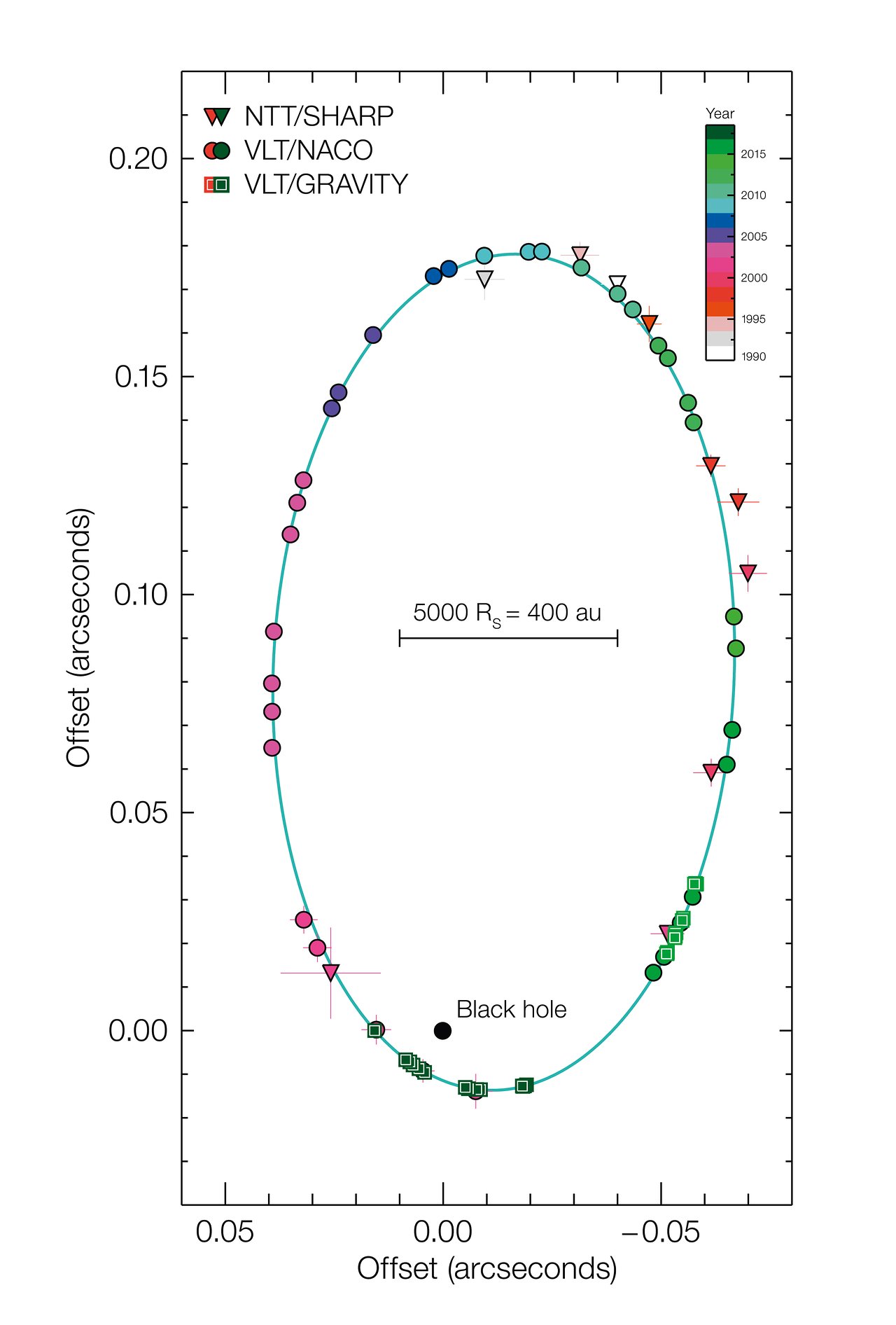
That's young. The Sun is about 4.6 billion years old.
Why it's a puzzle. Stars form when clouds of gas collapse. Right next to a four-million-Sun black hole, tidal forces should pull a cloud apart before it can collapse.
Alternatively, they formed farther out and moved inward. But that trip would have to fit inside a lifetime of a few million years, which is hard to arrange.
A third possibility is that S2 only looks young, for example because it is the product of stellar collisions or mergers. The 2003 authors found none of these options fully satisfactory.
Unresolved: did these stars form in place under unusual conditions, migrate in some way we haven't pinned down, or only appear young? It's still debated.
2. The G objects
Established. G1 was found by Andrea Ghez's group in 2005 (Keck). G2, a dusty object on a path that took it close to Sgr A*, was reported in late 2011/early 2012 by a team in Germany (Gillessen et al., Nature).
G2 was first interpreted as a gas cloud. When it made its closest pass in 2014, much of its outer gas was stretched, but its dusty core stayed compact. That survival led one team to argue G2 has a central star.
In 2020 a team led by Anna Ciurlo (UCLA) reported four more such objects, all lying within 0.04 parsecs of Sgr A* (Nature). Their widely varying orbits, the authors wrote, show the objects "were commonly but separately formed."
Unresolved: are G objects gas clouds, or stars wrapped in dust? They look like gas and dust but move like stars. One proposal, favored by the UCLA team that discovered the newer objects, is that they are the products of binary-star mergers, where two stars combine into one puffed-up object. There is no consensus yet.
3. The Fermi bubbles
Established. NASA's Fermi Gamma-ray Space Telescope revealed two giant lobes of gamma-ray light. They rise above and below the plane of the galaxy, each about 25,000 light-years tall, and they have relatively sharp edges.
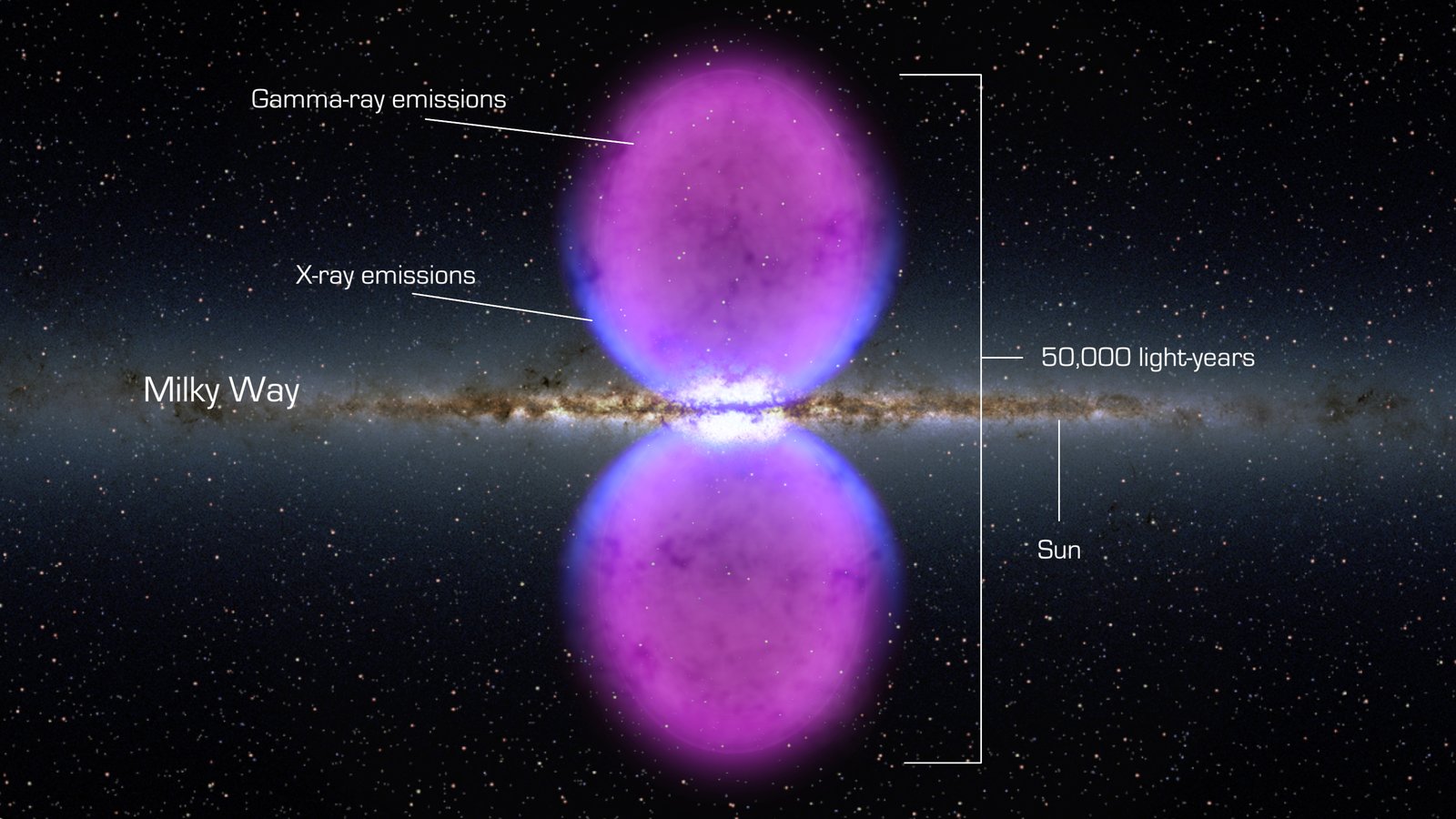
They may be young on cosmic timescales, possibly only a few million years old, though estimates depend on which origin is right (NASA SVS; Su, Slatyer & Finkbeiner 2010).
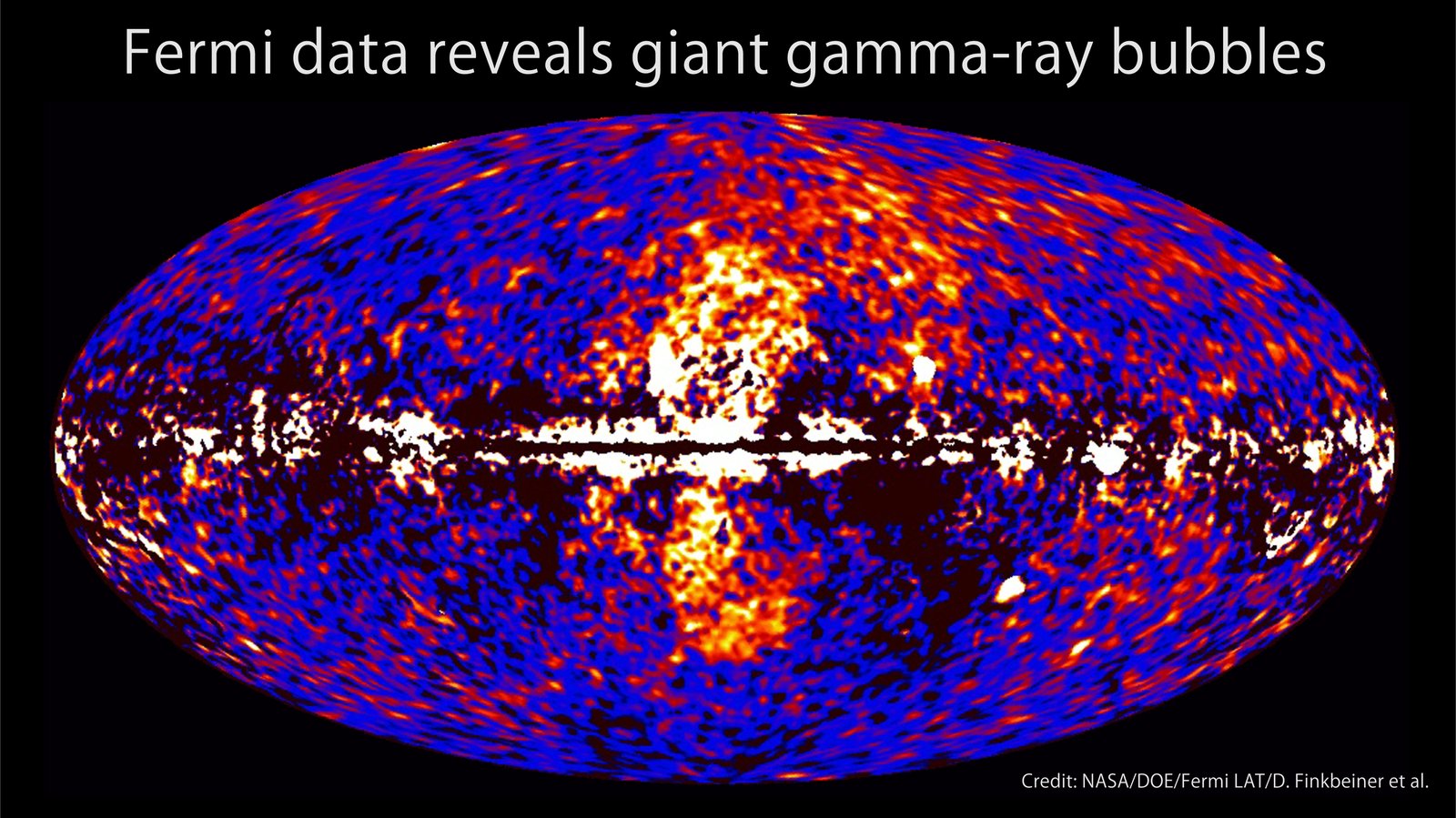
Why it's a puzzle. Inflating structures this big took enormous energy. Yet today Sgr A* is remarkably faint for a supermassive black hole, shining at only a tiny fraction of the maximum (Eddington) rate a black hole of its mass could sustain (Gillessen et al. 2012; Yusef-Zadeh et al. 2025).
Unresolved: the main explanations are still competing.
- A past outburst from Sgr A*, when it was swallowing far more material.
- A burst of central star formation, driving winds outward.
- A hybrid of both.
None has been ruled out. A 2023 PNAS news feature describes the origin as still a mystery.
4. The 511 keV positron line
Established. Positrons are antimatter electrons. When one meets an electron, both annihilate into gamma rays at exactly 511 keV.
ESA's INTEGRAL observatory has mapped this glow. Its SPI spectrometer shows the bulge and the disk emitting roughly equal total power in this line (a luminosity ratio of about 1.0 ± 0.1), as summarized in Thomas Siegert's 2023 review "The Positron Puzzle". That ratio is derived from the measured brightness using assumed distances to the bulge and disk.
Why it's a puzzle. The bulge glows about as brightly in this line as the much larger disk does. That ratio doesn't match how the usual suspected sources are spread across the galaxy.
Unresolved: we don't know where the positrons come from. Candidates discussed in the review include:
- radioactive nuclei made in stars and stellar explosions (aluminum-26, titanium-44, and the nickel-56 → cobalt-56 chain from supernovae)
- compact objects such as X-ray binaries and pulsars
- Sgr A*'s past activity
- flares on ordinary stars
- dark matter
5. The GeV excess
Established. NASA's Fermi Large Area Telescope sees more few-GeV gamma rays from the inner galaxy than standard models predict.
The excess is consistent with dark-matter particles of roughly 50 GeV (some fits allow up to about 200 GeV) annihilating. It is also consistent with a large population of millisecond pulsars too faint to see individually (Murgia 2020, Annual Reviews).
Researchers disagree about which is more likely. Some, like Dan Hooper, argue recent analyses make dark matter "significantly more likely". Others argue for pulsars (for example, Bartels, Krishnamurthy & Weniger 2016).
This is not a detection of dark matter. Both explanations are still alive.
Unresolved: dark matter, pulsars, or some mix of the two? Settling it will take better data and models.
A note on the "final parsec"
The "final parsec problem" sometimes comes up alongside the galactic center. It concerns pairs of supermassive black holes and how they get close enough to merge.
Sgr A* is a single black hole, so the problem doesn't apply to it directly.
Separately, pulsar-timing arrays have reported evidence for a nanohertz gravitational-wave background, whose strength fits expectations for pairs of supermassive black holes across the universe, though other origins aren't ruled out.
What these mysteries have in common
Each starts with a measurement, not a guess: an instrument pointed at the center found something current models don't fully explain. That's what an open question looks like in science.
Some may turn out to have ordinary explanations. Others may teach us something new about star formation, black-hole history, or particle physics. We can't promise which.
What we can say is that the center of our galaxy is still teaching us.
Image credits
- Sgr A* (EHT, 2022), ESO image eso2208-eht-mwa: EHT Collaboration. Licensed under CC BY 4.0. https://www.eso.org/public/images/eso2208-eht-mwa/
- Sgr A* in polarized light (EHT, 2024), ESO image eso2406a: EHT Collaboration. Licensed under CC BY 4.0. https://www.eso.org/public/images/eso2406a/
- Orbit diagram of S2, ESO image eso1825c: ESO/MPE/GRAVITY Collaboration. Licensed under CC BY 4.0. https://www.eso.org/public/images/eso1825c/
- Flaring Disk Around Milky Way's Black Hole (Artist's Concept): Illustration: NASA, ESA, CSA, Ralf Crawford (STScI). https://science.nasa.gov/missions/webb/webb-reveals-rapid-fire-light-show-from-milky-ways-central-black-hole/
- Fermi bubbles illustration (NASA SVS 10688): NASA/Goddard Space Flight Center. https://svs.gsfc.nasa.gov/10688
- Fermi all-sky 1–10 GeV bubble map (NASA SVS 10688): NASA/DOE/Fermi LAT/D. Finkbeiner et al. https://svs.gsfc.nasa.gov/10688
ESO and EHT images are shown unaltered. NASA images were resized and converted to JPEG for the web; no other changes were made. No images were edited with AI.
Mention of ESO, EHT, NASA, ESA or the Nobel Foundation does not imply endorsement.
Sources
- Ghez et al. 2003, ApJ 586, L127 (paradox of youth, S2 spectrum): https://iopscience.iop.org/article/10.1086/374804 · arXiv: https://arxiv.org/abs/astro-ph/0302299
- GRAVITY Collaboration 2018, A&A 615, L15 (S2 pericentre ~120 AU): https://arxiv.org/abs/1807.09409
- Gillessen et al. 2012, Nature 481, 51–54 (G2 discovery; Sgr A* faintness): https://www.nature.com/articles/nature10652
- Witzel et al. 2014, ApJL (G2 survives periapse): https://arxiv.org/abs/1410.1884
- Ciurlo et al. 2020, Nature 577, 337–340, "A population of dust-enshrouded objects orbiting the Galactic black hole" (doi:10.1038/s41586-019-1883-y): https://arxiv.org/abs/2001.08325
- W. M. Keck Observatory, G objects release (G1 history): https://keckobservatory.org/g-objects-2/
- NASA SVS 10688, Fermi bubbles: https://svs.gsfc.nasa.gov/10688
- Su, Slatyer & Finkbeiner 2010, "Giant gamma-ray bubbles from Fermi-LAT: AGN activity or bipolar Galactic wind?" ApJ 724, 1044–1082 (doi:10.1088/0004-637X/724/2/1044): https://arxiv.org/abs/1005.5480
- Mann 2023, PNAS 120(47), e2318720120 (news feature, not a research paper): https://www.pnas.org/doi/10.1073/pnas.2318720120
- Siegert, T. 2023, "The Positron Puzzle," Ap&SS (review): https://link.springer.com/article/10.1007/s10509-023-04184-4 · arXiv: https://arxiv.org/abs/2303.15582
- Murgia 2020, "The Fermi–LAT Galactic Center Excess: Evidence of Annihilating Dark Matter?" Annu. Rev. Nucl. Part. Sci. 70, 455–483: https://www.annualreviews.org/content/journals/10.1146/annurev-nucl-101916-123029 (DOI: https://doi.org/10.1146/annurev-nucl-101916-123029)
- Hooper 2023, SciPost Phys. Proc. 12 (argues for a dark-matter origin): https://www.osti.gov/biblio/1987967
- Bartels, Krishnamurthy & Weniger 2016, PRL 116, 051102 (argues for a millisecond-pulsar origin): https://doi.org/10.1103/PhysRevLett.116.051102
- NASA, Webb flares of Sgr A* (Feb 18, 2025): https://science.nasa.gov/missions/webb/webb-reveals-rapid-fire-light-show-from-milky-ways-central-black-hole/
- Yusef-Zadeh et al. 2025, ApJL 980, L35: https://iopscience.iop.org/article/10.3847/2041-8213/ada88b
- GRAVITY Collaboration 2018, A&A 618, L10 (near-ISCO flares): https://www.aanda.org/articles/aa/full_html/2018/10/aa34294-18/aa34294-18.html · arXiv: https://arxiv.org/abs/1810.12641
- GRAVITY Collaboration 2020, A&A 636, L5 (Schwarzschild precession): https://www.aanda.org/articles/aa/full_html/2020/04/aa37813-20/aa37813-20.html
- NANOGrav 2023, 15-year GW background: https://arxiv.org/abs/2306.16213
Follow the work at the Galactic Center.
The physics of the Milky Way’s core, what’s measured and what’s still open, and the people working on it.
Explore the Galactic Center