Sagittarius A*: what we actually know
Mention of ESO, EHT, NASA or the Nobel Foundation does not imply endorsement.
About 27,000 light-years from here, at the center of the Milky Way, something heavy is sitting in the dark.
We can't see it directly. Yet we know its mass to within a few percent, and we have a picture of its shadow.
What Sgr A* is
Sagittarius A* (said "A-star," written Sgr A*) is a compact radio source at the center of our galaxy.
Around it is a mass of about four million Suns, packed into a region no larger than our solar system. The Nobel Prize announcement calls a supermassive black hole "the only currently known explanation" for this.
Note the wording: not proven, but the only explanation that currently fits. We will talk that way too.
How we weighed a black hole
You can't put a black hole on a scale. You can watch the stars near it.
Since the early 1990s, two teams, one led by Reinhard Genzel and one by Andrea Ghez, have tracked stars near the galactic center. According to the Nobel Prize announcement, they used the world's largest telescopes, developed methods to see through huge clouds of interstellar gas and dust, and refined techniques to compensate for distortions caused by Earth's atmosphere.
The star that tells us the most is S2 (the UCLA group calls it S0-2).
- It goes around Sgr A* about every 16 years.
- Its orbit is a very stretched ellipse, with an eccentricity of 0.88.
- At its closest point it passes about 120 AU from the black hole.
- At that point it moves at about 7,650 km/s, or roughly 2.55% of the speed of light. (GRAVITY Collaboration 2018)
That speed comes from gravity alone. Nothing is propelling this star. It is falling.
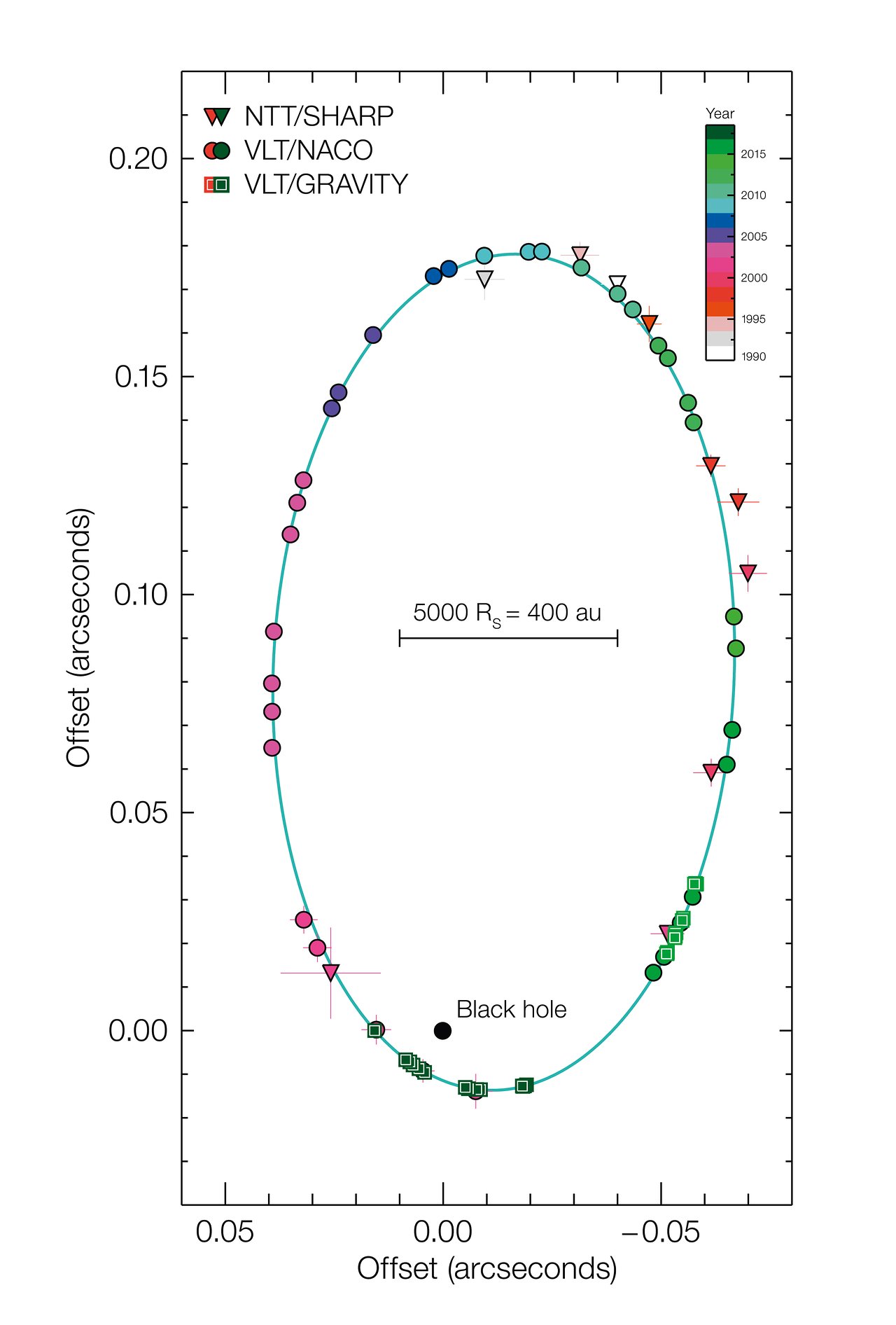
An orbit's size and period reveal the mass that controls it. In 2019, fitting 27 years of S2 data, the GRAVITY team found:
- Mass: 4.152 million solar masses (formal statistical uncertainty about 0.3%)
- Distance: 8,178 ± 13 (statistical) ± 22 (systematic) parsecs, about 26,700 light-years (GRAVITY Collaboration 2019)
That's a distance uncertainty of about 0.3%, combining statistical and systematic errors. The mass is less certain: a 2020 analysis found 4.26 million. Call it known to within a few percent.
In 2020, Genzel and Ghez shared half of the Nobel Prize in Physics "for the discovery of a supermassive compact object at the centre of our galaxy." Roger Penrose received the other half for his work on black-hole theory.
Photographing a doughnut on the Moon
On May 12, 2022, the Event Horizon Telescope (EHT) collaboration released the first image of Sgr A*. It shows a dark central "shadow" inside a bright ring of glowing gas.
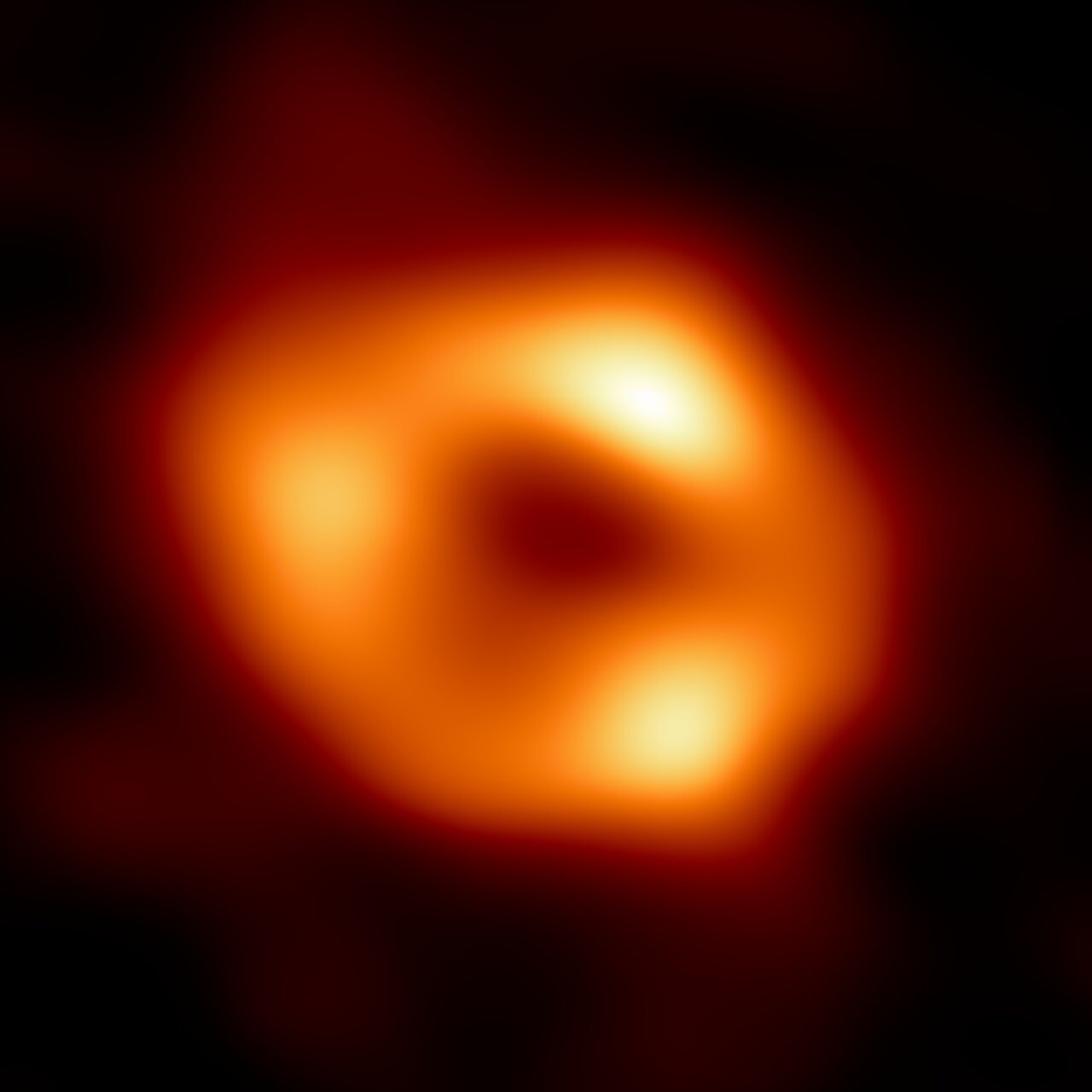
The EHT linked eight radio observatories into one Earth-sized virtual telescope, using 2017 data. More than 300 researchers from 80 institutes published the results in six ApJ Letters papers.
ESO compares its apparent size to a doughnut on the Moon.
Sgr A* also never stays still. As EHT scientist Chi-kwan Chan put it, gas takes days to weeks to orbit M87*, but around the much smaller Sgr A* it completes an orbit "in mere minutes." So the published image averages many reconstructions; it isn't a single snapshot.
The ring's size matched predictions. EHT Project Scientist Geoffrey Bower said: "We were stunned by how well the size of the ring agreed with predictions from Einstein's Theory of General Relativity."
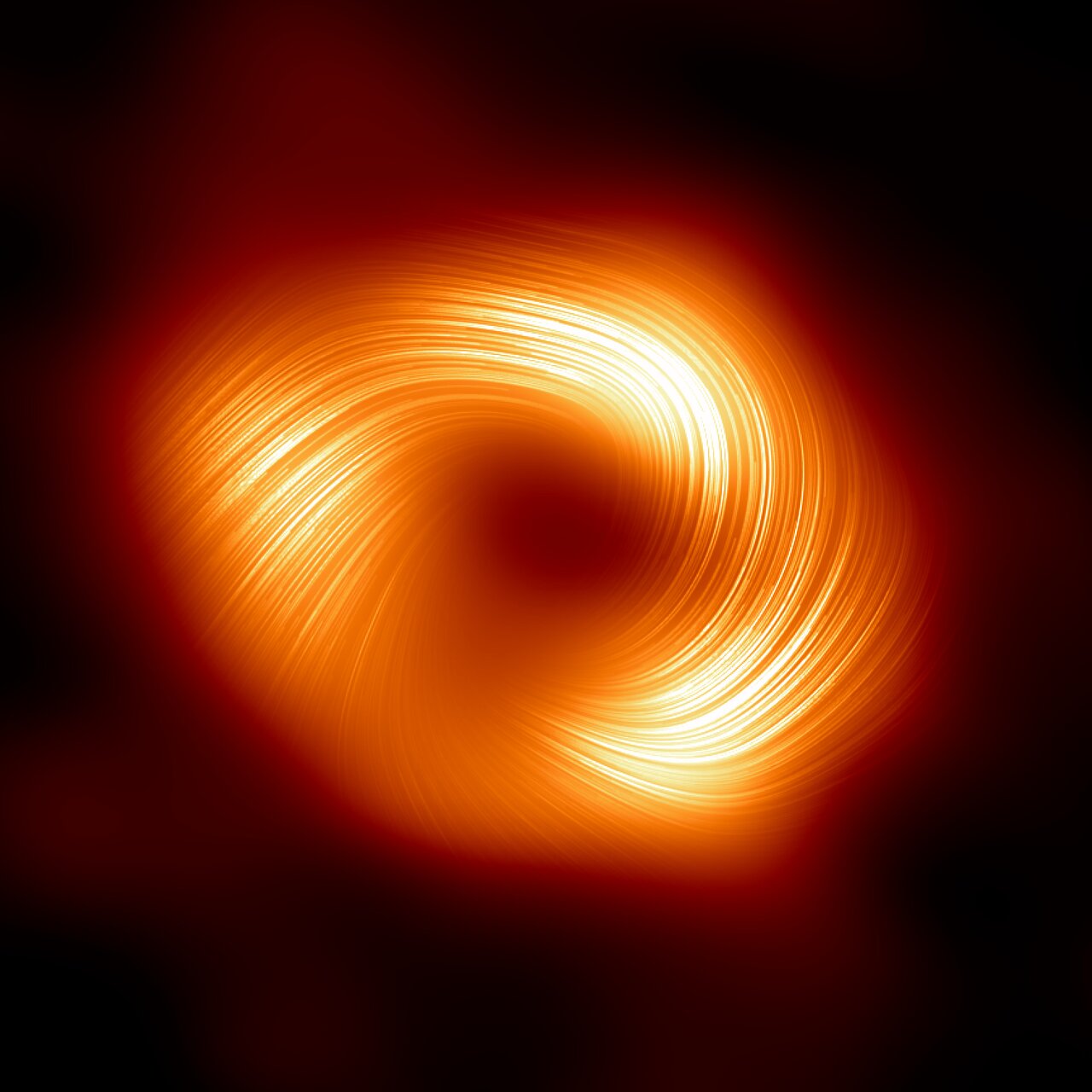
Then, on March 27, 2024, the EHT released an image of Sgr A* in polarized light. It showed "strong and organised magnetic fields spiraling from the edge" of the black hole. The pattern was strikingly similar to M87*, which has a powerful jet. (Paper VII; Paper VIII)
Einstein under extreme gravity
In the GRAVITY team's words, GR "so far has passed all experimental tests with flying colours" (A&A 615, L15). Sgr A* tests it around a mass four million times the Sun's.
Test one: gravitational redshift (2018). In May 2018, S2 made its closest pass. The GRAVITY instrument combines all four 8-meter VLT telescopes, which gives it the sharpness of a telescope about 130 m across. It measured S2's light stretched by about 200 km/s, from gravity and motion combined.
The team fitted a parameter where 1 means Einstein's prediction and 0 means Newton's. The result was f = 0.90 ± 0.09 (stat) ± 0.15 (sys). The data are "inconsistent with pure Newtonian dynamics" (A&A 615, L15).
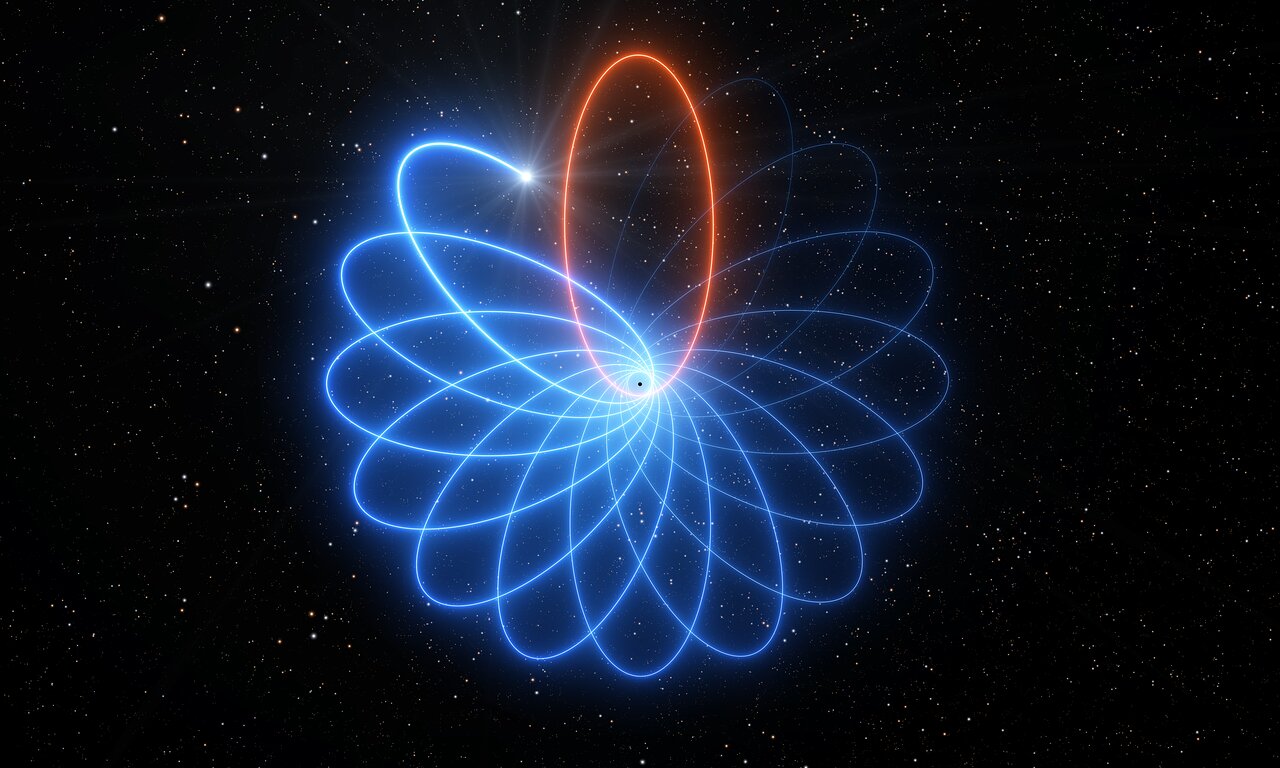
Test two: Schwarzschild precession (2020). In Newton's physics, S2 retraces the same ellipse forever. In Einstein's, the ellipse slowly turns. GRAVITY measured that turning at about 12 arcminutes per orbit. The fit gave f = 1.10 ± 0.19, which is "fully consistent with GR."
Any extended mass hidden inside S2's orbit (dust, faint stars, dark matter) is at most about 0.1% of the central mass.
Every test so far has confirmed general relativity. We're testing the limits of known physics, not finding new physics.
A black hole that never rests
Sgr A* isn't quiet. It flickers.
In 2018, GRAVITY saw three infrared flares that moved in loops. They fit a hot spot circling at 6–10 gravitational radii with a period of 33–65 minutes, close to the innermost stable orbit. This is a separate measurement from the EHT's "minutes" remark.
Then came JWST. NIRCam, its near-infrared camera, watched Sgr A* for about 48 hours in total, spread over seven observing periods in 2023 and 2024. The results were published in February 2025.
The material around the black hole produced five to six big flares per day, with smaller sub-flares between and "no periods of rest" (NASA Webb release, 2025).
The peer-reviewed paper (Yusef-Zadeh et al. 2025, ApJ Letters) adds:
- brightness changes on timescales of seconds
- a delay of 3–40 seconds between the 2.1 µm and 4.8 µm wavelengths
- magnetic fields of about 40–90 gauss, estimated by modelling the light curves
What drives them is open. That's the next article.
Why this matters for leaving Earth
Studying Sgr A* won't give us faster-than-light travel. It won't give us a new engine.
It does offer two real things.
First, a laboratory. ESO calls Sgr A* "a unique laboratory for testing physics in an otherwise unexplored and extreme regime of gravity." The theory under test, general relativity, is also built into everyday technology. GPS clocks need relativistic corrections of about 38 microseconds per day. The galactic center didn't give us GPS. It does check the same theory under far harsher conditions.
Second, instruments. The Nobel Prize announcement credits the laureates with new techniques for compensating for atmospheric distortion and with building unique instruments. The EHT needed new analysis tools, supercomputers to combine the data, and eight observatories acting as one Earth-sized telescope. Hard problems lead to better tools, and that's how we expect to make progress.
The bigger argument, clearly labeled as theory, comes in later articles. This is the base: what we can measure.
Follow the series at marsfirst.space/galactic-center.
Sources
- Nobel Prize in Physics 2020, press release: https://www.nobelprize.org/prizes/physics/2020/press-release/
- GRAVITY Collaboration 2018, A&A 615, L15 (S2 gravitational redshift): https://www.aanda.org/articles/aa/full_html/2018/07/aa33718-18/aa33718-18.html
- ESO eso1825 (gravitational redshift): https://www.eso.org/public/news/eso1825/
- GRAVITY Collaboration 2018, A&A 618, L10 (near-ISCO flares): https://www.aanda.org/articles/aa/full_html/2018/10/aa34294-18/aa34294-18.html
- GRAVITY Collaboration 2019, A&A 625, L10 (distance and mass): https://www.aanda.org/articles/aa/full_html/2019/05/aa35656-19/aa35656-19.html
- GRAVITY Collaboration 2020, A&A 636, L5 (Schwarzschild precession): https://www.aanda.org/articles/aa/full_html/2020/04/aa37813-20/aa37813-20.html
- ESO eso2006 (Schwarzschild precession): https://www.eso.org/public/news/eso2006/
- ESO eso2208 (EHT image of Sgr A*, 2022): https://www.eso.org/public/news/eso2208-eht-mw/
- ESO eso2406 (EHT polarization, 2024): https://www.eso.org/public/news/eso2406/
- EHT Sgr A* Paper VII, ApJL 964, L25: https://iopscience.iop.org/article/10.3847/2041-8213/ad2df0
- EHT Sgr A* Paper VIII, ApJL 964, L26: https://iopscience.iop.org/article/10.3847/2041-8213/ad2df1
- NASA, Webb reveals rapid-fire light show from Milky Way's central black hole (2025): https://science.nasa.gov/missions/webb/webb-reveals-rapid-fire-light-show-from-milky-ways-central-black-hole/
- Yusef-Zadeh et al. 2025, ApJL: https://iopscience.iop.org/article/10.3847/2041-8213/ada88b
- Ashby 2003, Relativity in the Global Positioning System, Living Reviews in Relativity: https://link.springer.com/article/10.12942/lrr-2003-1
Follow the work at the Galactic Center.
The physics of the Milky Way’s core, what’s measured and what’s still open, and the people working on it.
Explore the Galactic Center