The light-speed thesis
Here is the idea behind this whole series, stated plainly.
MarsFirst's working theory: studying the physics of the galactic center could speed up humanity's progress dramatically.
The pattern we're betting on
The thesis rests on a pattern in the history of science. It has two parts.
First, hard astronomy problems force extreme instruments. You can't track a star near a black hole about 27,000 light-years away with ordinary tools. So people build better ones.
Second, tests of fundamental theory sometimes end up under everyday technology. GPS is the classic case. It rarely happens right away, or in the way anyone predicted.
The GPS example, with its caveat
General relativity (GR) is in your pocket. GPS satellite clocks have to be corrected for it.
Gravity makes the satellite clocks run fast by about 45 microseconds a day, and their orbital speed makes them run slow by about 7, for a net of roughly 38 microseconds a day (our arithmetic from Ashby 2003). As Ashby puts it, without carefully accounting for these relativistic effects, "the system would not work."
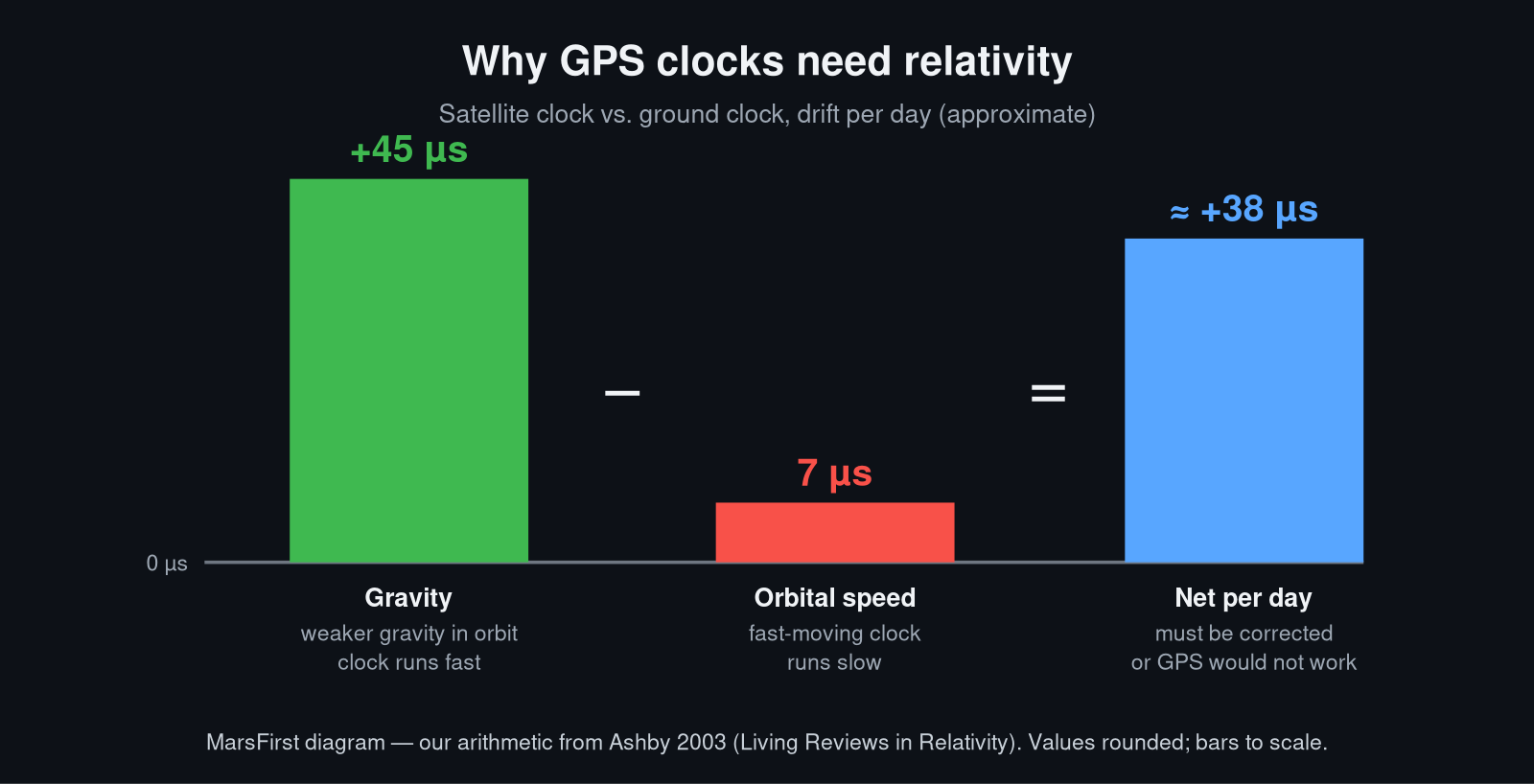
Now the caveat, stated just as plainly: this did not come from galactic-center research. GPS relies on GR as tested near Earth. The galactic center tests the same theory around a mass about four million times the Sun's. It did not give us GPS.
What GPS shows is the general shape of the pattern. A theory that once looked purely academic became infrastructure.
Instruments that had to be invented
The galactic center has pushed instruments hard.
To track stars around Sgr A*, the teams led by Reinhard Genzel and Andrea Ghez refined "new techniques to compensate for distortions caused by the Earth's atmosphere," building "unique instruments" (Nobel press release).
Much of that work is adaptive optics: correcting atmospheric blur in real time. The S2 tracking relied "mainly" on "adaptive optics (AO) instruments on the ESO VLT", SINFONI and NACO (GRAVITY Collaboration 2020). The 2020 Nobel Prize in Physics recognized the discovery these techniques made possible.
GRAVITY combines light from all four 8-meter VLT telescopes. That gives it the resolution of a telescope about 130 m across.
The Event Horizon Telescope went further. Imaging Sgr A* meant linking radio observatories into an Earth-sized virtual telescope. It also took sophisticated new tools to account for the fast-moving gas, supercomputers to combine and analyse the data, and a library of simulated black holes to compare against.
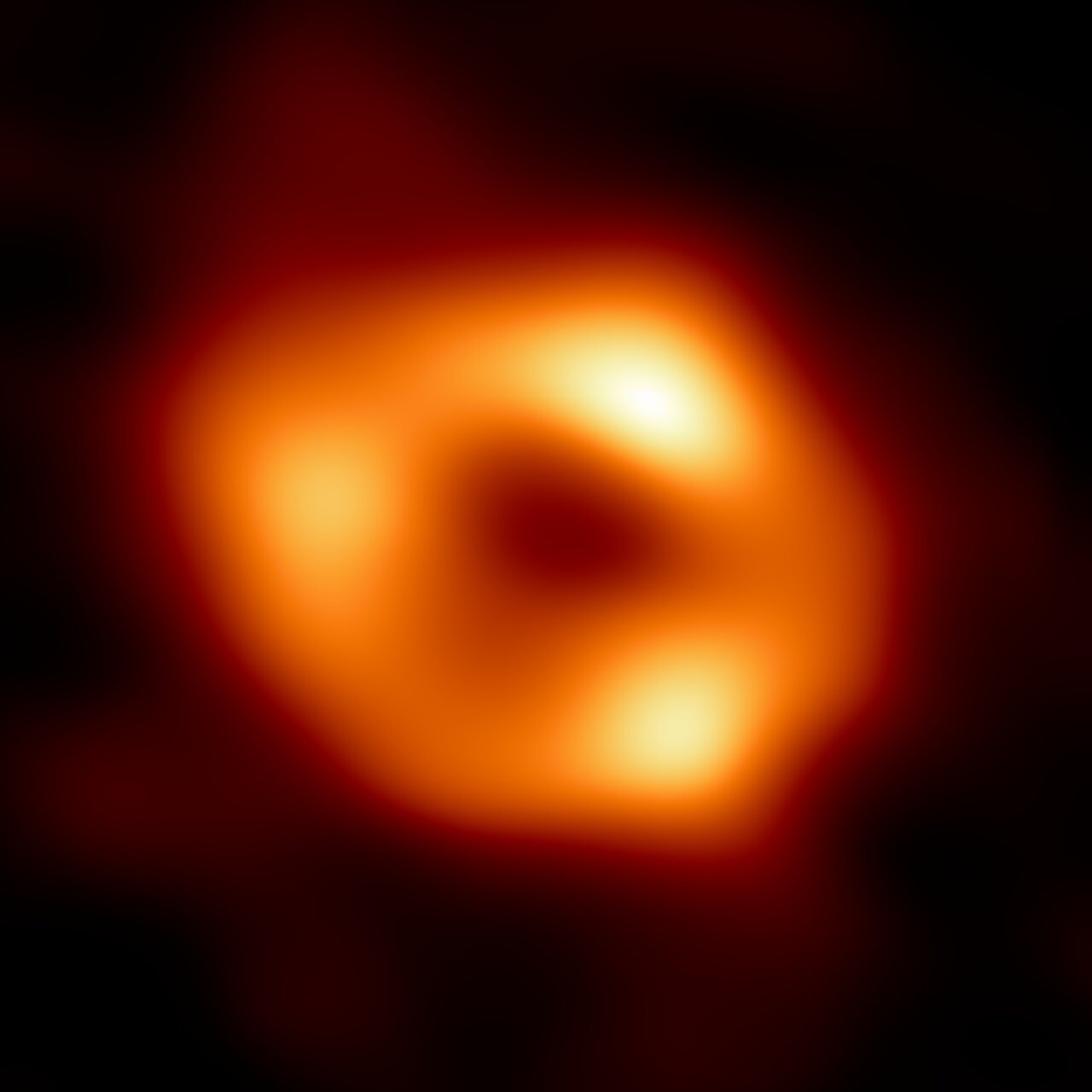
Those are real advances in measurement. Where they travel next is an open question, and we'll come back to it.
Why the galactic center specifically
If the bet is "hard problems drive progress," why point it here?
Because there are few places in reach where gravity is this extreme. ESO says Sgr A* and the star cluster around it provide "a unique laboratory for testing physics in an otherwise unexplored and extreme regime of gravity."
The tests are already happening. S2's light showed gravitational redshift. Its orbit precesses by about 12 arcminutes per lap, as Einstein predicts. The same analysis shows that any extended mass hidden inside S2's orbit can be no more than about 0.1% of the central mass.
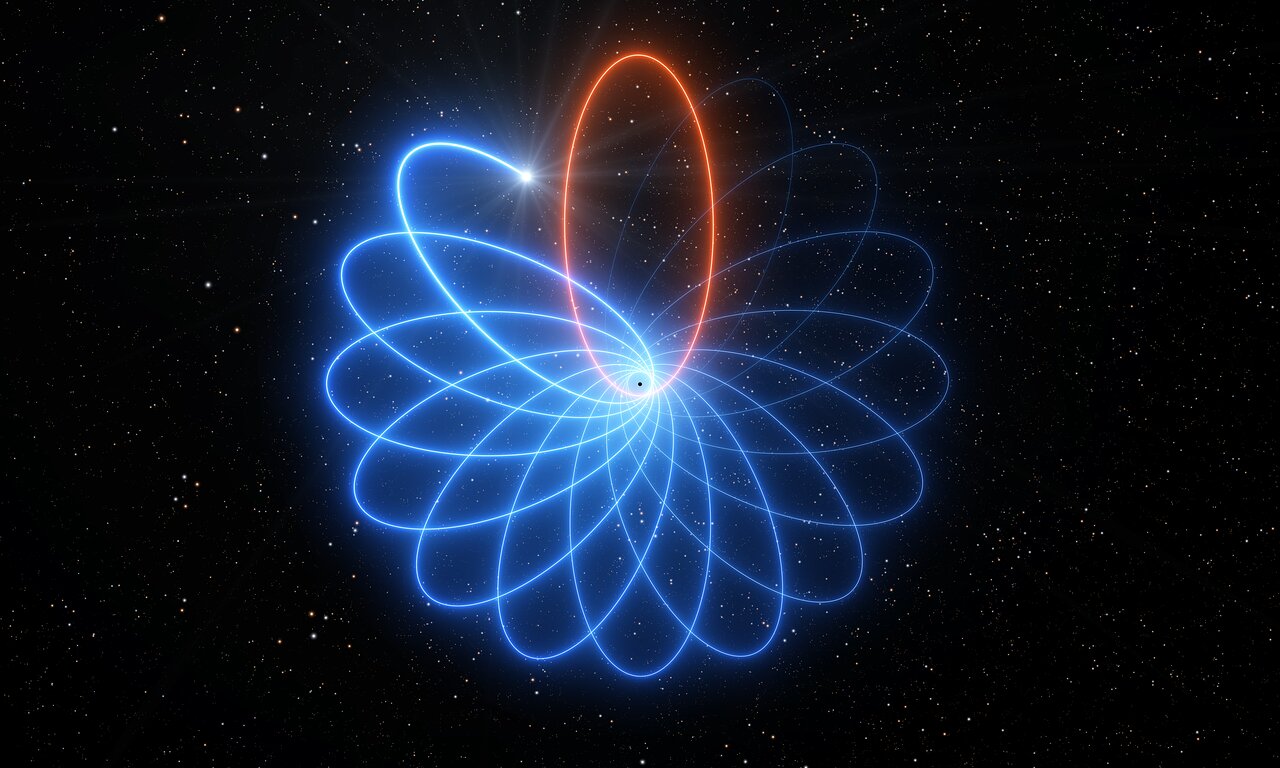
Here's the honest part: every test so far agrees with GR. There is no new physics yet. What the galactic center offers is a way of pushing the limits of known physics, not proof that those limits have broken.
David Haviland, chair of the Nobel Committee for Physics, pointed to the same frontier: "questions about how to test our theory of gravity under the extreme conditions in the immediate vicinity of a black hole."
Open questions that could guide particle physics
The galactic center also holds unexplained signals.
- The GeV excess. Fermi-LAT sees extra gamma rays from the inner Galaxy. They are consistent with dark matter particles of roughly 50 GeV, though there is also "some evidence" they come from unresolved sources such as millisecond pulsars (Murgia 2020). It is unresolved.
- The 511 keV line. Light from annihilating positrons glows across the inner Galaxy, with the bulge shining about as brightly as the whole disk, a pattern that matches no known source population. Where those positrons come from is a half-century-old puzzle. Pulsars, other astrophysical sources, and dark matter have all been proposed.
Plausible, not proven: if either signal is eventually pinned down, it could guide particle physics. That depends on mysteries nobody has solved yet. Neither is a dark-matter detection.
What we are NOT claiming
A thesis is only as honest as its limits. So here are ours.
- No faster-than-light travel. Nothing in the research we cite points to it.
- No propulsion or energy method from black holes. No source supports one, and we won't imply one.
- S2's speed is not a human achievement. At closest approach, S2 moves at about 7,650 km/s, roughly 2.5% of the speed of light. That is a star swinging through a deep gravity well on its 16-year orbit. It isn't a propulsion insight.
- No named spinoff. We aren't naming a technology that came out of galactic-center research, because we can't document one.
- "Light-speed" is not literal. It's a name for an ambition about pace, not a physics claim.
If you see someone claiming more than this in our name, they've gone beyond what we've said.
Why the bet is still worth making
So why make a bet we can't prove?
Because the defensible version is strong on its own: hard astronomical problems drive extreme instruments, and they keep testing the theories our technology depends on. As ESO's Xavier Barcons said of the S2 measurements, "It was a huge challenge to develop the uniquely powerful instruments needed to make these very delicate measurements and to deploy them at the VLT."
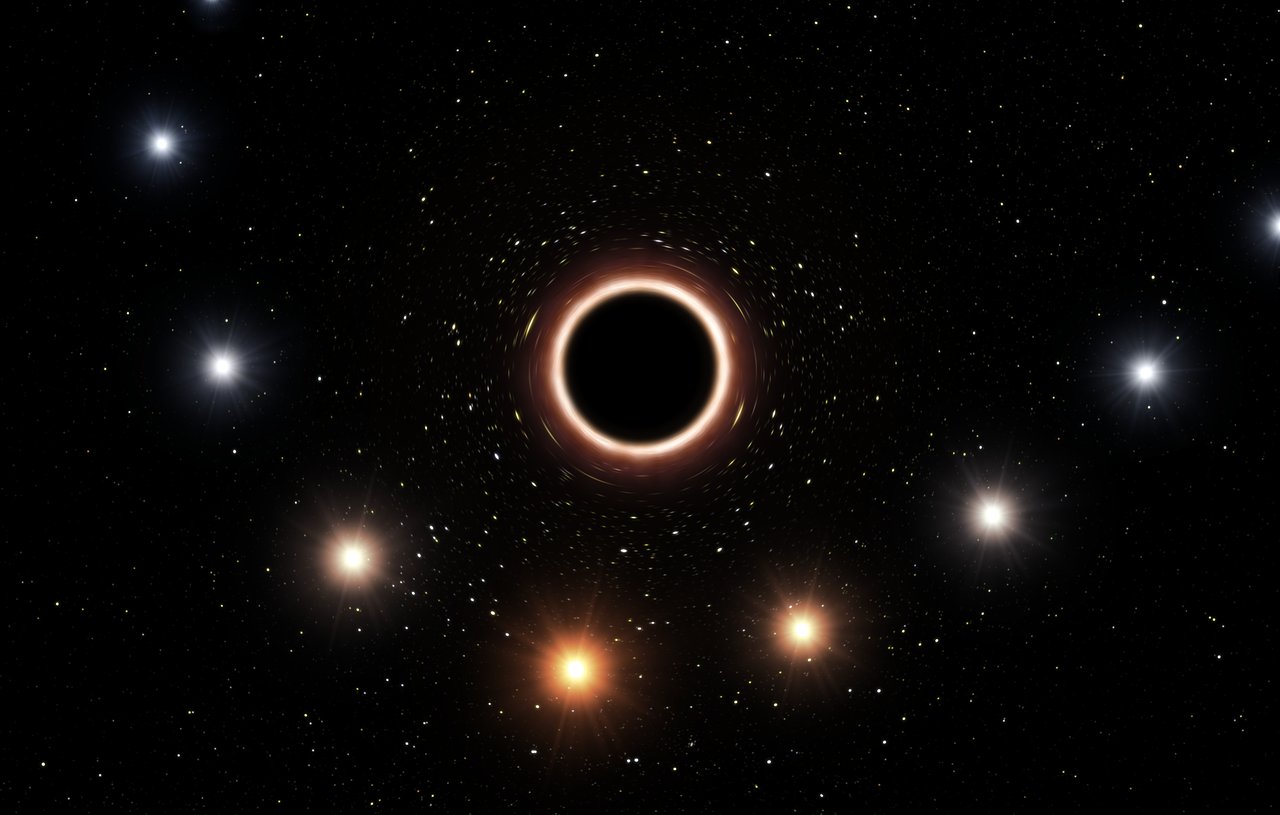
The galactic center is one of the hardest measurement problems we have. Weighing a black hole to within a few percent took decades of patience. So did imaging something like a doughnut on the Moon, and timing gas that circles in minutes.
MarsFirst thesis — our view, not a finding. Rigorous, curious science seems to pay off over a long time and in ways nobody forecasts. The usefulness tends to come later, from unexpected directions. Work like the galactic-center campaigns trains people, sharpens tools, and keeps theory honest. If anything accelerates a civilization over the long run, we think it looks like this.
As David Haviland, chair of the Nobel Committee for Physics, put it, these exotic objects "still pose many questions that beg for answers and motivate future research." (Nobel)
If the bet interests you, follow the rest of the Galactic Center series at marsfirst.space/galactic-center.
Mention of ESO, EHT, NASA or the Nobel Foundation does not imply endorsement.
Images: ESO and EHT images are used under the Creative Commons Attribution 4.0 International License (CC BY 4.0); credits as shown. Images are unaltered. The GPS diagram is an original MarsFirst graphic.
Sources
- Ashby 2003, Relativity in the Global Positioning System, Living Reviews in Relativity: https://link.springer.com/article/10.12942/lrr-2003-1
- Nobel Prize in Physics 2020, press release: https://www.nobelprize.org/prizes/physics/2020/press-release/
- ESO eso2006 (Schwarzschild precession; "unique laboratory"): https://www.eso.org/public/news/eso2006/
- ESO eso2208 (EHT image of Sgr A*, 2022): https://www.eso.org/public/news/eso2208-eht-mw/
- ESO eso1825 (gravitational redshift; Barcons quote): https://www.eso.org/public/news/eso1825/
- GRAVITY Collaboration 2018, A&A 615, L15 (S2 gravitational redshift; S2 speed): https://www.aanda.org/articles/aa/full_html/2018/07/aa33718-18/aa33718-18.html
- GRAVITY Collaboration 2019, A&A 625, L10 (distance and mass): https://www.aanda.org/articles/aa/full_html/2019/05/aa35656-19/aa35656-19.html
- GRAVITY Collaboration 2020, A&A 636, L5 (Schwarzschild precession; SINFONI/NACO adaptive optics): https://www.aanda.org/articles/aa/full_html/2020/04/aa37813-20/aa37813-20.html
- Murgia 2020, Annual Review of Nuclear and Particle Science 70:455 (GeV excess): https://www.annualreviews.org/content/journals/10.1146/annurev-nucl-101916-123029
- Siegert 2023, "The Positron Puzzle," Ap&SS: https://link.springer.com/article/10.1007/s10509-023-04184-4
- ESO image eso2208-eht-mwa: https://www.eso.org/public/images/eso2208-eht-mwa/
- ESO image eso2006a: https://www.eso.org/public/images/eso2006a/
- ESO image eso1825a: https://www.eso.org/public/images/eso1825a/
Follow the work at the Galactic Center.
The physics of the Milky Way’s core, what’s measured and what’s still open, and the people working on it.
Explore the Galactic Center